

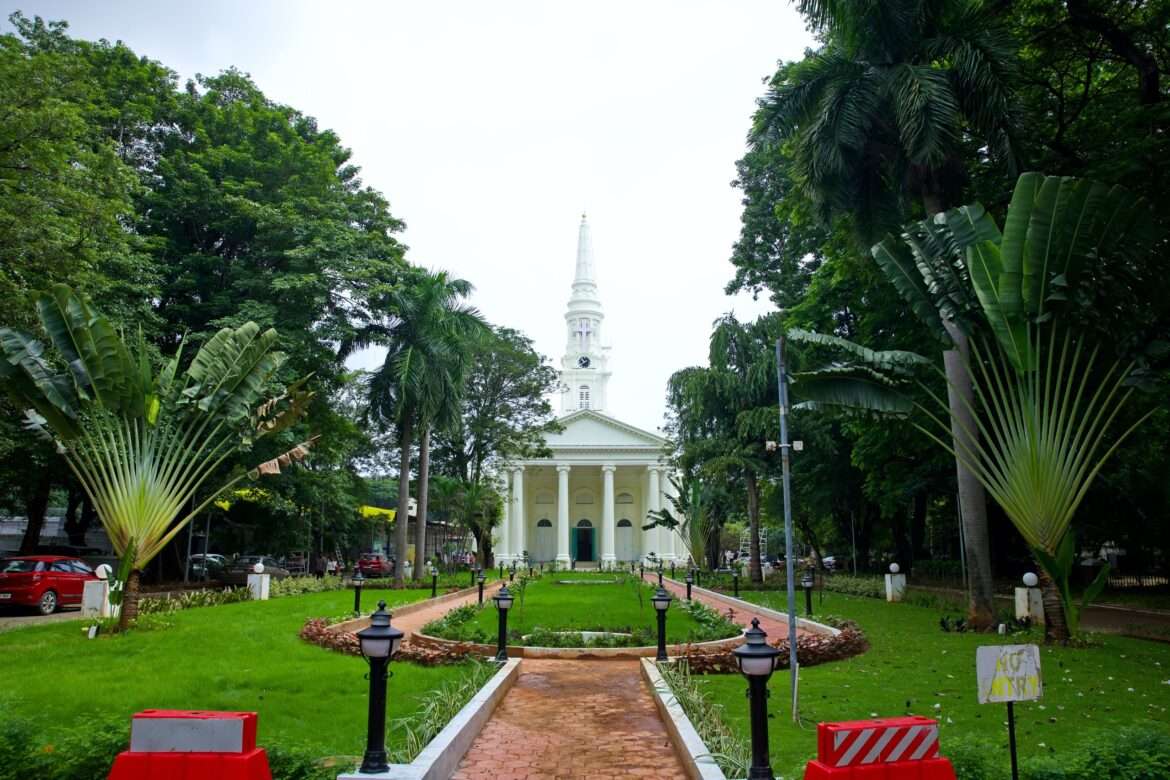
St. George’s Cathedral, located on Cathedral Road in Chennai stands as one of the most iconic monuments of colonial architecture in India. Consecrated in 1815, it was built during the British East India Company’s rule and served as the spiritual heart of the Anglican community in South India. Designed in the Neo-Classical style, the cathedral features a majestic spire, elegant Corinthian pillars, and a serene white façade, symbolizing simplicity and grandeur in equal measure.
Over the years, the cathedral has not only been a place of worship but also a witness to Chennai’s urban evolution. It is the mother church of the Church of South India (CSI) and the seat of the Bishop of Madras, making it one of the most historically and spiritually significant Christian landmarks in the region.
After over two centuries of existence, St. George’s Cathedral began showing signs of deterioration caused by environmental factors, pollution, humidity, and urban development pressures. The tropical climate of Chennai, with its monsoon rains and high humidity, had led to cracks and peeling in the lime plaster and masonry walls, corrosion of metal elements, decay of timber components due to termite infestation and moisture and water seepage, leading to the weakening of the roof and internal finishes.
In addition to physical decay, the cathedral faced challenges of urban encroachment and vibrations from nearby vehicular traffic, threatening its structural stability and tranquil environment.
Given its architectural, cultural, and religious significance, there arose an urgent need to restore and conserve the building, not only to preserve its heritage but also to ensure that it continues to serve its spiritual and community functions for future generations.
Writing about the occasion the Bishop in Madras, the Rt Rev Paul Francis Ravichandran said, “Our vision is not simply a beautiful building, but a vibrant and unified Cathedral community where worship is offered, where the marginalised find welcome, where young and old discover purpose, and where the love of Christ is made visible in thoughts, words and deeds. With thanksgiving, hope, and prayer, I commend this restored Cathedral to the glory of God and to the service of His people.”
The Restoration Process
The restoration of St. George’s Cathedral has been undertaken with great care, guided by the principles of architectural conservation, ensuring that the original materials and craftsmanship are retained as much as possible.
The Convenor of the restoration project was Col. David Devasahayam, Chairman of the Radiant Group of Companies and a member of the congregation. Professor Arun Menon, Dept of Civil Engineering, IIT Madras, and Coordinator, National Centre for Safety of Heritage Structures (NCSGS) prepared the detailed project report. His inputs and contributions were invaluable to the project.
Documentation and Assessment
The first phase involved detailed documentation of the building’s condition, including mapping structural cracks, moisture ingress, and deterioration patterns. Historical records, photographs, and drawings were studied to understand the original construction techniques and materials.
Structural Stabilization & Material Conservation
Engineers reinforced weakened structural elements, especially in the spire and roof trusses. Lime mortar, rather than cement, was used to maintain authenticity and breathability of the structure. Damaged wooden doors, pews, and window frames were restored or replaced with treated teak wood. Metal elements were cleaned and coated with anti-corrosive treatments. Modern yet reversible waterproofing techniques were applied to prevent water seepage, while preserving the building’s aesthetic and structural integrity.
Interior & Artistic Restoration
The stained-glass windows, memorial plaques, and altar area were delicately cleaned and conserved. Lighting and ventilation systems were upgraded to ensure both functionality and preservation. Efforts were made to restore the surrounding gardens and improve drainage to prevent future moisture damage, while maintaining the peaceful ambience of the cathedral grounds.
Through the integration of these modern technologies, the restoration of St. George’s Cathedral reaffirms that preservation and progress can coexist in harmony. The Cathedral Presbyter Rev Dr Ruben Jayakumar said, “I give thanks to each member of our congregation and every friend who contributed their resources, time and prayers, for this work was never about preserving bricks and mortar alone. This work of restoration is not an ending, but a new beginning.” By preserving St. George’s Cathedral, Chennai reaffirms its commitment to safeguarding its colonial-era architectural heritage, ensuring that this sacred space continues to inspire awe and devotion for centuries to come.